

You know that tiny dark spot on your tooth? The one you’ve been ignoring because it doesn’t hurt? Maybe you figured it would just stay the same. Maybe you’re hoping it will go away on its own. It won’t. Tooth decay doesn’t pause. It doesn’t heal. It marches forward like a slow-moving train, and the longer you wait, the worse the damage gets. Treatment can quickly escalate from a simple filing to a more complex crown or even tooth loss.
Here’s exactly what happens when you leave a cavity untreated; step by step.
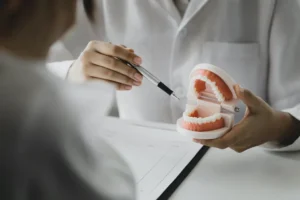
Stage 1: The Enamel Attack
Tooth decay starts quietly. Bacteria in your mouth feed on sugar and produce acid. That acid eats through your enamel, the hardest substance in your body. At this stage, you won’t feel anything. No pain. No sensitivity. Just a tiny white or brown spot that’s easy to miss.
If you catch it here, a simple filling is all you need. The dentist drills out the decay, fills the hole, and you’re done. One appointment, no drama, minimal cost.
Stage 2: The Dentin Invasion
The decay keeps drilling deeper and reaches the dentin, the softer, yellowish layer beneath your enamel. Now your tooth starts sending signals. You might notice a twinge when you eat something sweet or drink something cold. The sensitivity comes and goes, so you ignore it.
The problem is, decay spreads faster in dentin than in enamel. What was a small spot is now a growing cavity. You still need a filling, but it’s bigger now. More tooth structure is gone. The filling might need to be deeper or wider.
Stage 3: The Pulp War
The bacteria reach the pulp, the innermost chamber where your nerve and blood vessels live. Now the real pain begins. The tooth throbs. Cold drinks make you wince. You can’t bite down without a zing of pain. Sometimes the tooth aches for no reason at all, especially at night.
This is a root canal situation. The dentist removes the infected pulp, cleans the chamber, and seals it up. Then you need a crown on top to protect the weakened tooth. More appointments. More expense. But your tooth can still be saved.
Stage 4: The Abscess and Infection
If you still ignore the pain, the infection spreads beyond the tooth root into the surrounding bone. Your body fights back, but it’s losing. Pus builds up at the tip of the root. That’s an abscess. You might notice:
- A pimple-like bump on your gum
- Swelling in your face or jaw
- A bad taste in your mouth
- Fever or general sickness
Your immune system can’t reach the bacteria inside the tooth. Antibiotics can calm the infection temporarily, but they can’t fix the root problem. At this stage, you need either a root canal, urgently, or extraction.
Stage 5: The Extraction
Eventually, there’s nothing left to save. The crown is gone. The root is destroyed. And the infection has damaged so much bone that the tooth is loose. Or maybe it broke off at the gum line. At this point, the only option is extraction. The tooth comes out.
Now you’re facing not just an extraction, but also replacing that missing tooth. An implant. A bridge. Something to keep neighboring teeth from shifting into the gap. The simple filling you could have gotten months ago? That now seems like an impossible dream.
Don’t Wait Until It Hurts
Tooth decay never improves on its own. It only gets deeper, more painful, and more expensive. The sooner you act, the easier and cheaper the fix. Dr. Dhara Patel at Best Dental Spa has seen every stage of decay, from the tiniest spot to teeth that crumble in her hands.
Pain is the last symptom, not the first. If you have a cavity, don’t count on it hurting to tell you something’s wrong. By the time it hurts, you’re well past stage one.
Call Best Dental Spa today to schedule an exam. A small spot today is an easy fix. A missing tooth tomorrow is a whole project. Choose the quick visit.
